

What Is a Bitcoin Private Key? How Seed Phrases Are Generated, and Why Randomness Is Everything
By the Stacked Team
Updated August 2026
What is a bitcoin private key?
A bitcoin private key is a number. Nothing more mystical than that: a single, enormous number, picked at random, that gives whoever holds it the ability to spend whatever bitcoin is associated with it. Every address you've ever seen, every balance you've ever checked, ultimately traces back to one of these numbers. Own the number, own the bitcoin. Lose it, and the bitcoin is unreachable, not just to you but to anyone.
That number is drawn from an almost incomprehensibly large range, roughly 2^256 possibilities. The field guide covers just how large that range is; the short version is that guessing one by chance isn't a realistic risk. The real risk sits one step earlier, in how that number gets picked in the first place. If the process that chose it wasn't actually random, the range you're relying on shrinks, sometimes drastically, and a number that looked unguessable becomes anything but.
What is a seed phrase, and how does it relate to your private key?
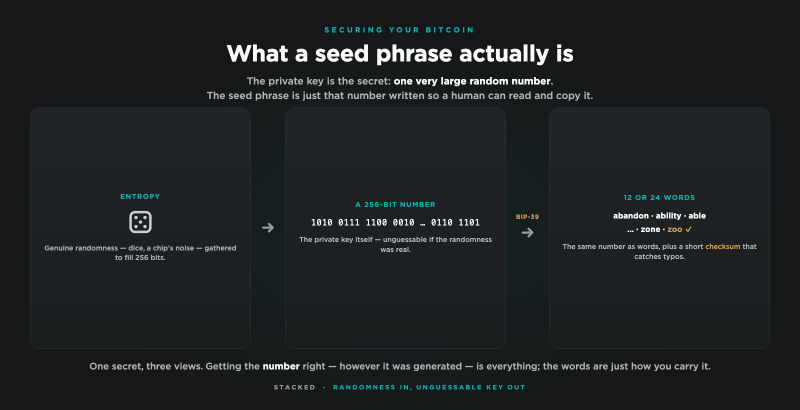
Nobody memorizes a 256-bit number, so bitcoin wallets don't ask you to. Instead, they convert it into a seed phrase, usually 12 or 24 plain English words, using a standard called BIP-39. The standard defines a fixed list of 2,048 words and the exact rules for translating a private key into a specific sequence of them, and back again. Write the words down in order and you've backed up the number. Read them into any BIP-39-compatible wallet and you've restored it.
This matters because it's easy to treat the seed phrase itself as the secret. It isn't, not exactly. The private key is the secret; the seed phrase is a human-readable encoding of it, with a small built-in checksum that catches simple transcription errors, a mistyped word, a swapped pair, before they cost you funds. Get the words right and you get the number right. Get the number right, however it was generated, and you get everything that depends on it.
Where does the randomness in a private key actually come from?
Somewhere, a private key has to actually get chosen, and that means gathering enough genuine unpredictability, or entropy, to fill 256 bits. There are a few broad ways this happens, and understanding the categories matters more than memorizing any one implementation.
Hardware randomness is the most common source: a dedicated chip, or a general-purpose processor, sampling physical noise, electrical jitter, timing variance, and feeding it through a random number generator designed to turn that noise into unbiased bits. Done well, this is fast, convenient, and genuinely strong. Done poorly, biased hardware or a flawed algorithm can quietly produce numbers that look random but aren't.
Human-supplied randomness is the other broad category: physically rolling dice, flipping coins, or drawing from a shuffled deck, enough times to accumulate the needed entropy, then converting the results into a private key by hand or with an offline tool. This shifts trust away from a chip you can't inspect and onto a physical process you can watch happen. It's slower and not automatically better; a shortcut like rolling ten times and repeating them undermines it just as thoroughly as bad hardware does.
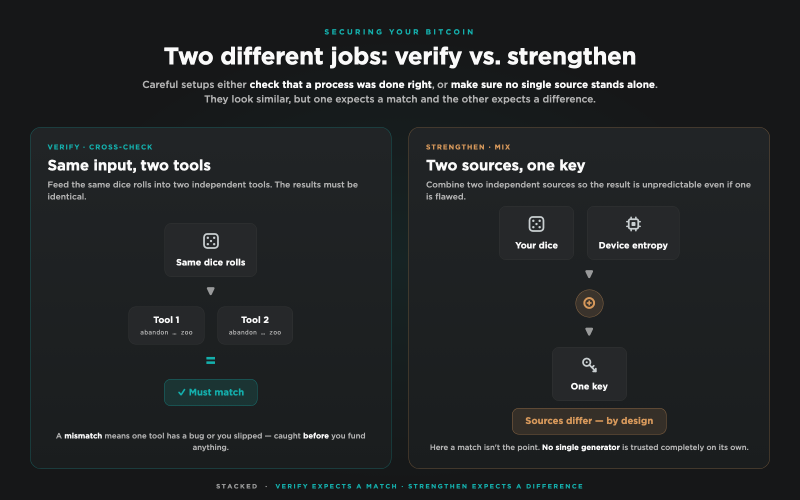
Most careful setups don't pick one source and stop. They combine or cross-check, so no single generator has to be trusted completely on its own. That covers two different jobs: verifying a process was done right, and strengthening a key so no single source stands alone.
-
Cross-check the encoding. Generate your entropy once, say from a dice roll, then feed those same rolls into two independent tools, ideally from different makers. Both should derive the identical seed phrase, down to the checksum word. A match confirms the BIP-39 math was done right in both; a mismatch means one has a bug, or you slipped, and you caught it before funding anything. This only works because the input is shared: two devices each generating their own entropy will produce different phrases, and that's correct, not a failure.
-
Verify the phrase's checksum. Most wallets, and a number of offline tools, will confirm a phrase's built-in checksum is valid, a fast catch for a mistyped or swapped word. That confirms the encoding, not the strength of the randomness behind it; a weak seed with every word spelled right still passes a checksum check.
-
Mix independent sources so none stands alone. Add your own dice-rolled contribution on top of a device's hardware entropy, so the result stays unpredictable even if one source turns out flawed. Here the outputs are supposed to differ. The point isn't a match, it's that no single generator was trusted completely.
Which combination you use matters less than the principle: no single source, hardware or human, is asked to be right entirely on its own.
What does weak randomness actually look like?
Weak randomness rarely announces itself. It doesn't produce an error message. It produces a seed phrase that looks exactly like a strong one, twelve or twenty-four ordinary words, sitting inside a much smaller, more guessable range than 2^256.
This tends to happen for a handful of general reasons, none unique to any one product or brand. A random number generator can carry a subtle bug that narrows its actual output range. A device can seed its randomness from something predictable, a timestamp, a serial number, a counter, rather than genuine physical noise. Older or unmaintained firmware can carry a flaw that a later update fixed, invisibly, for anyone who never updated it. And in the worst case, a generator can be deliberately weakened, built to look random while secretly drawing from a much smaller set an attacker already knows.
None of this is detectable by looking at the words themselves. A weak seed phrase reads exactly like a strong one. That's what makes the process that generated it, not the phrase itself, the thing worth scrutinizing.
What sanity checks can you run before you trust a device with real money?
The single point of failure here is trust in one source: one manufacturer, one device, one method you found in a guide somewhere. You don't need to audit silicon to close that gap. A few habits go a long way.
Buy hardware directly from the manufacturer or an authorized retailer, rather than a secondhand or unverified source. Keep firmware current; randomness bugs, when they're found, tend to get fixed. Verify your seed phrase on the device's own screen during setup, not just on a connected computer, so nothing between the two can quietly substitute what you're recording.
For a stronger check, run the same-input cross-check described above with two independent tools, ideally from different manufacturers, so a single flawed implementation isn't the common thread.
Generating your own entropy by hand, dice rolls are a well-understood method, is a legitimate option too, using a device only to compute and verify the resulting BIP-39 checksum rather than to generate the words itself. Like any method, it's shortcuts that make it risky: skipping rolls, rounding up a count, reusing a sequence. Find a well-documented process, follow it exactly, and take it as seriously as you'd take a hardware device. Trusting yourself to do it right is its own kind of risk, no different in kind from trusting a manufacturer to do it right; understand the method, take it seriously, and it holds up fine.
Either way, don't ask one method to secure everything on its own. Mixing generation paths, and pairing them with multisig so no single key can move funds alone, reduces the damage any one weak link can do. Whichever method you use, the check that matters most comes after generation, not during it: test that you can restore the wallet from the recorded phrase before you fund it with anything you'd miss.
Should you ever regenerate a seed you already have?
Sometimes. The question isn't really about the phrase, it's about your trust in the process that created it. If you later learn that the specific method, device, or firmware version you used had a randomness flaw, the honest response isn't to inspect the phrase harder. It's to treat the funds behind it as exposed and move them to a freshly generated key you trust more, using a method you've verified this time.
This isn't a verdict on any specific product; it's a general principle worth adopting regardless of what generated your current keys. Trust in a generation method is provisional, not permanent. When new information erodes that trust, act on it rather than hoping it doesn't apply to you.
Where should you go from here?
This is the generation stage of the field guide's coin lifecycle, in more depth: back up to the field guide for how it fits alongside backup, access, signing, and the rest. If you're weighing whether to spread key generation across multiple independent methods and devices, that's a multisig decision; the multisig guide covers why no single key, however it was generated, should be able to move funds alone.
FAQ
What is entropy in a bitcoin wallet?
Entropy is the raw unpredictability used to create a private key. Enough of it, gathered genuinely at random, makes a key unguessable; too little, or entropy that isn't as random as it looks, makes a key weak.
Are dice rolls safer than a hardware wallet's built-in randomness?
Not automatically. Dice remove reliance on a chip you can't inspect, but introduce reliance on doing the roll count and encoding correctly. Many setups use both, checking one against the other, rather than picking a single source and trusting it completely.
Can two different people ever end up with the same seed phrase?
In practice, no. The range of possible 256-bit keys is so large that a genuine collision, two independently generated strong keys landing on the same value, isn't a realistic risk. It becomes a risk only when the generation process is weak enough to produce far fewer possible outcomes than it should.
Is a seed phrase generated on a phone safe?
It depends entirely on the app's randomness source and how well it protects that phrase from ever leaving the device, not on the fact that it's a phone. A phone with weak entropy is exactly as risky as any other device with weak entropy.
How do I know if my seed phrase is secure?
You can't verify it by reading the words. What you can verify is the process: reputable hardware, current firmware, on-device confirmation, and ideally a cross-check against a second independent method. If any of those were missing when a key was generated, treat that key as worth regenerating.
This is general education, not financial or security advice.