

Bitcoin Cold Storage Self-Custody: A Practical Security Field Guide
How to find the single point of failure in your setup
By the Stacked Team
Updated August 2026
Why does a single point of failure matter more than anything else in cold storage?
Every bitcoin theft, loss, or lockout traces back to the same shape of mistake: something important depended on exactly one thing, and that one thing failed. One seed phrase, kept in one place. One device, holding one key. One person, who knew the passphrase and is no longer reachable.
That's a single point of failure, or SPOF: any part of your setup where, if it breaks, gets lost, or gets stolen, your bitcoin goes with it. A SPOF isn't automatically wrong. For small amounts, simplicity is often the right trade. But once you're holding real value, the question changes from "is this easy?" to "what happens if this one thing fails, and have I actually planned for it?"
That question is the spine of this guide. Bitcoin cold storage security isn't a single decision you make once; it's a practice: make a plan, write it down, then stress-test it against specific failure modes. What if a hardware wallet manufacturer goes out of business? What if you lose access to the location where your backup lives? What if a device breaks or gets damaged in a fire? Walk each scenario through your actual setup and ask whether it survives. If it doesn't, you've found a single point of failure worth removing.
Nobody outside your household should be able to tell you exactly how your bitcoin is secured. Treat every specific example below as an illustration of a principle, not a template to copy.
How should you use this guide?
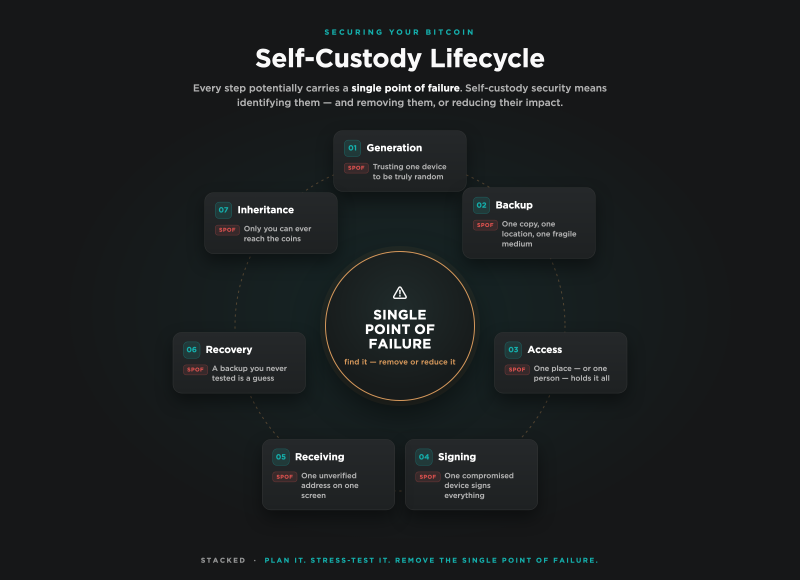
Bitcoin cold storage security isn't one decision. It's a sequence of decisions that a coin passes through over its life: it gets created, backed up, accessed, spent, received, recovered, and eventually inherited. At each stage, ask the same three questions:
-
What actually happens here?
-
Where's the single point of failure?
-
How do you remove it, or at least shrink it?
One more thing before you start: this guide assumes you're building toward multisig, a wallet needing signatures from more than one key to move funds, because that's the structural answer to the SPOF problem and lets each stage speak concretely about quorums and descriptors. If you hold a single key, the same three questions still apply; the fix will usually be better backups and more discipline rather than a quorum.
Two of these stages, generation and multisig, are big enough that they get their own deep-dive articles. This guide covers the principle at each stage; the seed-phrase guide and multisig guide go deeper on those two. Read this guide first. It's the map. The deep-dives are the terrain.
How is a bitcoin seed actually created, and why does randomness matter so much?
A bitcoin wallet is, at its core, a very large random number, converted once into a seed phrase (usually 12 or 24 words) for humans to record. Every key and address your wallet ever uses is derived from it. If someone else can guess or reproduce that number, they own your bitcoin; if you lose it, so does everyone, forever.
That means the entire security of your wallet rests on one property: how random was the process that created it? This is where the first SPOF in a coin's life shows up, and it's an unusually sneaky one, because you often can't verify it just by looking.
The reason this matters is scale, not superstition. A private key is drawn from roughly 2^256 possibilities, a number in the same range as the estimated number of atoms in the observable universe. Correctly guessing one on a single try is like reaching into that entire universe and picking out one specific atom, blind. That's the security a genuinely random key provides, and it's exactly what a weak or predictable generation process quietly throws away.
Randomness is hard to generate and even harder to verify. A device generating a seed relies on hardware and firmware you didn't write and can't fully inspect; if that source is weak, biased, or compromised, the seeds it produces may be far more guessable than they look. Trusting "the device did it, so it must be random" is itself the SPOF: one device, one manufacturer, one piece of firmware, with no way to check its work.
The fix isn't to trust harder. It's to reduce reliance on any single source, without becoming paranoid about it. If you trust a hardware wallet, don't rely on only one: generate entropy on two independent devices and check that they agree. Or, since every key in a multisig setup doesn't need the same generation method, mix devices, or mix a device with a manual, dice-based method, so a single flawed process can't touch every key at once. Either way the SPOF shrinks. You don't need to be paranoid about one hardware wallet generating a key; you just can't let your entire safety rest on it. The mechanics live in the seed-phrase deep-dive.
How do you back up your keys so they survive you?
A backup exists to answer one question: if this key disappeared right now, could you get it back? A seed phrase on a single piece of paper in a single drawer is a backup in name only, stacking three single points of failure: one copy, one location, one fragile medium that fire, water, or time can destroy.
You don't need a flawless backup of every key in every setup. What you need is a clear answer, for each key you hold, to "what happens if this specific copy is gone?" That might mean multiple copies in different locations, a more durable medium than paper, or simply knowing exactly how you'd replace a key that turns out to be gone.
In a multisig setup, one detail gets missed constantly: backing up the keys isn't enough. You also need to back up the descriptor, the record specifying exactly which keys, in what combination and order, reconstruct your wallet. Keeping the descriptor without the keys gets you nowhere; keeping every key without the descriptor can leave you locked out, or forced into a slow, uncertain reconstruction. Treat the descriptor as its own asset, worth its own backup plan.
How do you make sure you can actually reach your keys when you need them?
The real question here isn't security versus convenience in the abstract. It's specific: how quickly do you need to reach your funds? An hour, a day, a week, a month? That answer decides how you place a multisig quorum. Keys you might realistically need soon should be reachable fast; keys that exist purely for a break-glass scenario, a lost device, a compromised location, a genuine worst case, can sit slower and safer, because you're not meant to reach for them casually.
The SPOF risk here is still structural, and multisig doesn't remove it automatically. A quorum where every key sits in one location, or where only one person can assemble a signature, hasn't removed anything; it's just moved the single point of failure from one key to one place or person. A single location is vulnerable to disaster and to simply being the one place an attacker needs to find. A single person who understands the setup is a SPOF too: if something happens to them, does anyone else know what to do?
There's no universal right balance. It depends on the amount involved and how urgently you'd need to act. What matters is setting your everyday-access keys and your break-glass keys apart deliberately, each sized to how long it should take to reach, rather than defaulting to whatever was easiest when you first set things up.
What happens when you sign a transaction, and where's the risk?
Signing is the moment a key actually does something: it produces cryptographic proof authorizing a transaction. It's also the moment a compromised setup does the most damage, since a single device that can sign has, in effect, the power to move everything.
It helps to separate what a "wallet" actually does, because multisig splits these jobs up rather than bundling them in one device: storing public keys and generating addresses, constructing a proposed transaction, signing it, and storing the private keys that can sign. In a well-built multisig setup, the first two jobs move off your signing devices onto coordinator software holding your descriptor, the one you backed up earlier. That coordinator knows your addresses and builds transactions, but it can't sign anything; only the offline devices holding your keys can, and it takes enough of them agreeing before funds move.
A signing device connected to the internet is a target every second it's online. Malware doesn't need to steal your seed phrase if it can wait for you to sign, then quietly alter what you're signing. Air-gapped signing, where a device never touches the internet and transaction data moves across the gap by QR code or SD card, closes off that attack path. Verifying transaction details on each signing device's own screen, not just on the coordinator, closes another: malware on a connected computer can display one thing while the transaction says another.
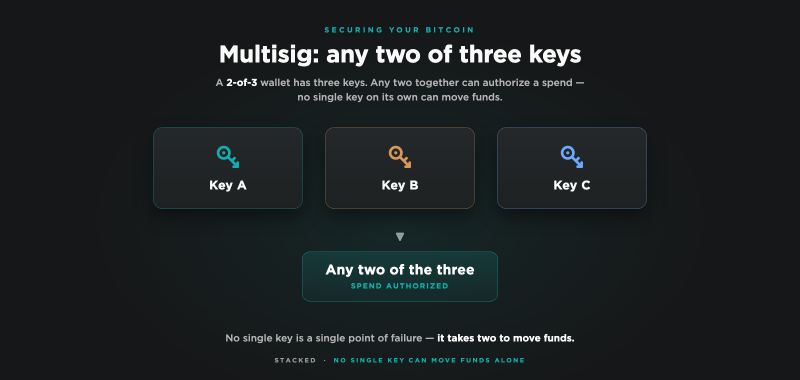
This is what multisig is for: no single compromised device, key, or location can move your bitcoin alone. An attacker needs multiple independent keys, ideally generated and stored in genuinely different ways, a categorically harder problem than compromising one. The mechanics belong to their own treatment: the multisig deep-dive.
How do you make sure bitcoin actually arrives where you think it's going?
Sending is a solved problem for the sender. Receiving is where things quietly go wrong, because the failure often isn't in your keys at all. It's in trusting a single screen.
The classic attack here is address-swapping malware: software that silently replaces the bitcoin address you copy or see on screen with one the attacker controls. You think you're sharing your own receive address, or verifying an incoming one, but the display has been tampered with. A single, unverified glance at a single screen is the SPOF.
The fix is to verify through a second, independent channel. In a multisig setup, addresses are normally generated and displayed by the coordinator software, not the individual signing devices, which makes that second check more important, not less: confirm the receive address on at least one signing device directly before you trust it. Basic address hygiene, a new receive address for each transaction rather than reusing one, also limits how much a single compromised address can cost you.
How do you know your backup will actually work?
An untested backup isn't a backup. It's a guess. The gap between "I wrote my seed phrase down" and "I have confirmed I can restore my full wallet from what I wrote down" is where a huge number of real losses happen, and it's invisible until the day you actually need to recover.
Recovery, done properly, is failure-mode thinking put into practice. Don't ask "do I have a backup?" Ask specific questions: if this hardware wallet breaks tomorrow, what exactly do I do, step by step? If I can't get to the location where a key or backup is stored, what's my path? If I need to reconstruct a multisig wallet from its descriptor and only some of the keys, does that actually work?
Answering these questions in the abstract isn't enough. Test them before you ever fund the wallet for real. Create your keys and backups, then send in a small test amount, not your real balance. Then simulate a failure on purpose: set some keys or backups aside, as if a device had broken or a location had become unreachable, wipe the wallet software, or start fresh, and rebuild using only what you'd have left. If you can reconstruct the wallet and see the test funds again, you've verified recovery, not assumed it. A full walkthrough belongs in a dedicated backup and recovery guide; the version here is the discipline, not the manual.
What happens to your bitcoin when you're gone?
Every stage so far has assumed you're the one operating the setup. Inheritance is the stage that removes that assumption. If you're the only person who can reach your keys, you are, yourself, the setup's single point of failure. Plan for that and the coins outlive you. Don't, and the security you built becomes the reason your heirs can never recover them.
The hard part is that inheritance information is dangerous while you're alive and useless if it's too well hidden after you're gone. A note with your seed phrase in a safe deposit box, opened only after your death, sounds tidy; in practice, treasure maps like this are hard to get right: too vague and nobody finds it in time, too specific and it becomes a target the moment it exists.
This is the stage that pushes people toward simpler, more structural setups rather than clever, bespoke ones. A multisig arrangement, where trusted parties each hold one key and none can move funds alone, can be handed down as a known structure and process, rather than a secret transmitted intact through documents, memory, or a locked box. The details belong in the multisig deep-dive; the principle belongs here: plan for your own absence as deliberately as you plan against theft.
Where should you go from here?
Generation, backup, recovery, and inheritance can look like four separate problems. They're the same problem seen at four different moments: whether you trusted one source, one copy, one untested assumption, or one person, yourself, to hold everything together. Multisig is the structural answer across all four, because it removes reliance on any single key rather than patching each stage separately. It doesn't remove the need to ask the three questions at every stage; it just raises how much each answer can remove.
This guide is the map, not the terrain. Two stages here, generation and multisig, have full deep-dive articles: how seeds are actually generated and verified, and how multisig works in practical detail. Both are where the principles above turn into concrete setup decisions.
If you're holding bitcoin with an exchange or platform today, moving toward self-custody is the natural next step once you've thought through the questions above. Stacked maintains a list of supported wallets if you’re ready to withdraw to a wallet you control.
FAQ
What is a single point of failure in bitcoin custody?
Any part of your setup where one failure, a lost device, a single backup copy, one person's availability, is enough to lose your bitcoin or your access to it. Removing SPOFs means no single event can cause total loss.
Is a hardware wallet enough on its own?
A hardware wallet solves part of the problem: it keeps your key away from internet-connected devices. It doesn't solve backup, recovery testing, or what happens if that device is lost, stolen, or discontinued. Treat it as one part of a plan, not the whole plan.
What's the difference between cold and hot storage?
Hot storage keeps keys on an internet-connected device, convenient for frequent, smaller transactions. Cold storage keeps keys generated and stored offline, better suited to larger amounts moved rarely. Most holders use both, sized to how they actually use their bitcoin.
How much bitcoin justifies cold storage?
There's no fixed threshold. The honest question is what it would cost you, in money or stress, if this amount was lost or stolen. When that cost outweighs the inconvenience of cold storage, it's time to set it up.
Do I need multisig, or is a single seed phrase enough?
It depends on the amount and your risk tolerance. A well-generated, well-backed-up single key removes many risks; multisig removes the risk that any one key, device, or location is a single point of failure. As amounts grow, more people move toward multisig.
What's the single biggest mistake people make with cold storage?
Treating setup as a one-time task instead of a plan they test. Never verifying a backup restores, or never asking what happens if part of the setup fails, is how untested assumptions turn into permanent losses.
This is general education, not financial or security advice.