

Multisig, Explained: When One Signature Isn't Enough
How M-of-N keys remove the single point of failure, and what that costs you
By the Stacked Team
Updated August 2026
What is multisig, and how is it different from a regular wallet?
A regular bitcoin wallet is single-sig: one private key, and whoever holds it can move the funds. Sign with that one key and the transaction is valid. Simple, and for a lot of holders, entirely appropriate. But it also means everything rests on that one key. Lose it, have it stolen, or get tricked into signing something you shouldn't, and there's no second check to stop it.
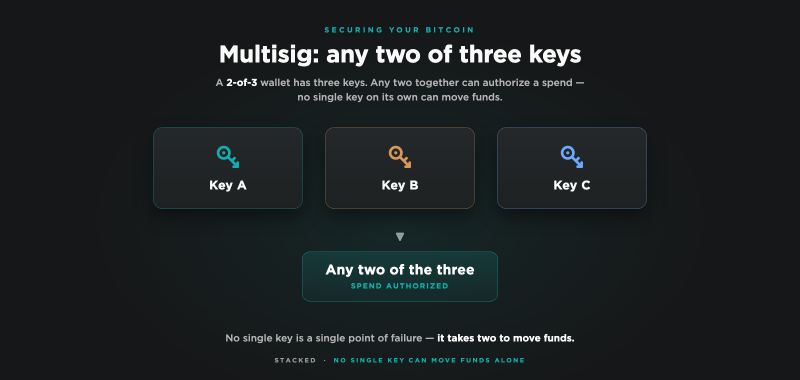
Multisig splits that authority across more than one key. A wallet is set up as "M-of-N": N keys exist in total, and any M of them together can authorize a spend. A 2-of-3 wallet has three keys; any two can sign, but one key alone can't. No single key is a single point of failure anymore, wherever it's stored, the same thesis the field guide walks through at every stage of a coin's life: multisig doesn't make any individual key stronger, it makes the wallet not depend on any one of them. Each key still needs to be generated well in its own right; the private key guide covers what that takes.
What problems does multisig actually solve?
Each key you require is one fewer thing that can fail on its own.
-
Theft of one device. Someone steals or compromises one hardware wallet. In single-sig, that's the whole balance gone. In 2-of-3, they still need a second key they don't have.
-
Loss of one backup. A seed phrase gets destroyed, misplaced, or simply can't be found when you need it. In single-sig, that's the end of the story. In multisig, your remaining keys still reach quorum, so you're not locked out: you can rotate to a replacement key instead of losing everything.
-
Coercion. Someone pressures you to hand over access. A single key handed over is the whole wallet. A single key handed over out of three or five is not enough on its own.
-
Inheritance. In single-sig, the only way for anyone else to ever reach the funds is to already hold the one key, which means trusting them with full access while you're alive. Multisig lets you give someone a key that's only useful combined with others, so access can survive you without handing over control today.
-
A flawed vendor or a weak generation process. A bug in one manufacturer's chip, or a flaw in how one key's randomness was generated, doesn't stop being a problem just because that key is one of several. This one isn't solved outright the way the others above are: a bad key is still a bad key. What multisig buys you is time: your remaining keys still reach quorum, so you're not locked out and not instantly exposed the moment the flaw comes to light. It's also the argument for generating your keys through different devices and manufacturers to begin with: a bug in one vendor's stack then only ever touches one key, not all of them. Trust in any single generation method is provisional, whether or not it's the only key you hold; the seed phrase guide covers why.
You can't swap a key inside an existing multisig wallet; its addresses are derived from the exact set of keys that created it. Rotating, whether a key was lost or just turned suspect, means standing up a new wallet with the keys you still trust plus a replacement, then sweeping the funds across from the old one. That only works for as long as you still control at least M of the original keys, which is exactly why it pays to rotate a suspect key early rather than wait and see if the flaw actually gets used against you.
None of this makes any individual key safer. It removes the situation where any one key's failure, whether through theft, loss, coercion, or a flaw in how it was made, is automatically the wallet's failure too.
What does multisig cost you in return?
It isn't free. You're trading a single point of failure for more moving parts, and more moving parts done carelessly create new ways to lose funds.
The most underrated cost is the descriptor: the record of exactly which keys, in what combination and order, make up your wallet. Your keys reconstruct your coins. The descriptor is what tells a wallet how to combine them to reconstruct your access. Lose it, and even holding every key you started with may not be enough to rebuild the wallet cleanly, especially if you're not using the same software you set it up with. It needs a backup of its own.
That backup can be more liberal than a key's, not less. A descriptor holds only public information: someone who gets hold of it still needs to control enough of the actual keys to spend anything. Extra copies don't carry the spending risk that extra copies of a seed phrase would. What it does expose, in the wrong hands, is the shape of your wallet and potentially your holdings, a privacy risk worth taking seriously. Redundancy and secrecy pull opposite directions here compared to a key: back it up generously, keep it out of public view.
Beyond that: more keys means more devices or backups to manage, more places something can be misplaced, and more setup steps where a mistake at the start (the wrong number of keys, a policy you didn't record properly) causes trouble later. The failure modes don't disappear with multisig. They change shape, and some of them are ones single-sig never had.
Who is multisig actually for, and when is it overkill?
It's worth the tradeoff when there's something meaningful to protect and time to set it up properly: larger holdings, funds shared across a family, savings held on a long horizon where a few extra steps to spend are a fair price for the added resilience.
It's usually overkill for smaller, everyday balances or money you want to move quickly, where the setup and backup burden outweighs what you're protecting. Single-sig, done well, with good generation (Seed Phrase Guide) and a solid backup, is a legitimate choice on its own for exactly that case.
How do people actually use multisig?
The specific patterns below are illustrations of how the M-of-N idea gets applied, not a recommendation to copy one.
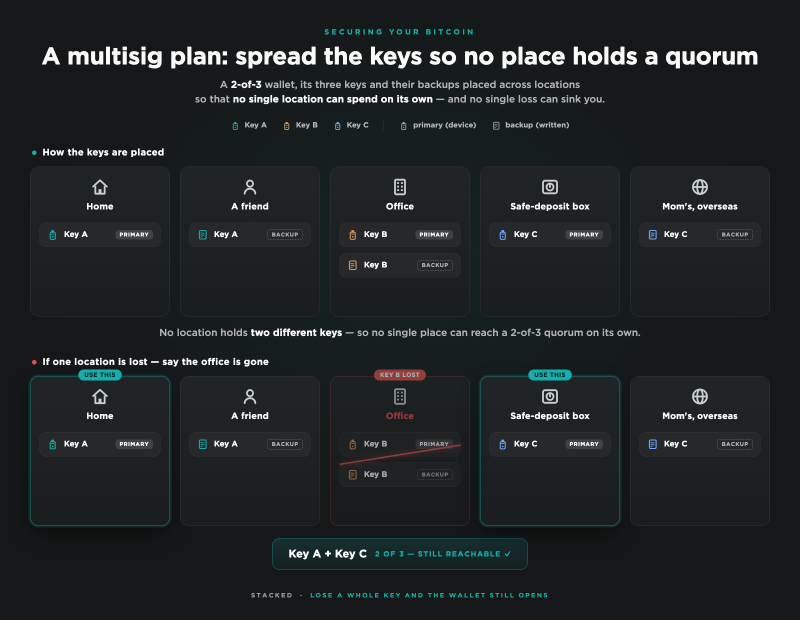
A 2-of-3 setup is the most common starting point: three keys, any two needed to spend. Larger or more formal setups sometimes use 3-of-5, spreading the quorum wider still. Keys are often kept in different physical locations, so a single disaster or theft can't reach more than one of them. Some setups bring in a third party, such as an institution, to hold one key in a collaborative arrangement, useful for recovery help or inheritance planning, but it changes the trust model: you're now trusting that party not to collude with whoever holds a second key, so weigh who else could plausibly reach it.
What does a plan look like before you set one up?
Multisig rewards being deliberate. Before generating anything, it's worth writing the plan down on paper and answering it in full, not while you're already halfway through setup:
-
Where will each key be stored, and on which device?
-
How will each key be backed up? Will every key have a backup, or have you decided some don't need one?
-
Where will those backups be stored, and are you genuinely comfortable keeping material at each of those locations?
-
Where and how is the descriptor itself backed up?
-
How easy do you actually want spending to be? Not how easy it happens to be with the setup you're picturing, but how easy you want it to be. Keep all your keys at home and you can reach quorum in minutes, but one fire or break-in now threatens more than one key at once. Split them across a home safe, a vault, and a location in another city, and reaching quorum might take days, which is exactly what makes any single event far less likely to reach enough of them. Neither is wrong; they're different answers to the same availability-versus-security balance the field guide covers at the Access stage.
Decide that first, spend within the hour or within a month, and design the quorum and key locations to match.
Where can you learn more, and set one up, responsibly?
This article is about whether and why multisig makes sense, not a step-by-step setup guide. If you decide it's right for you, Getting Started covers some basics wallet concepts, including wallets built for multisig, such as Nunchuk and Sparrow. Read their documentation closely, and put the plan above to work.
FAQ
What does 2-of-3 mean?
Three keys exist for the wallet. Any two of them, signing together, can authorize a spend. One key on its own can't move anything.
Do the keys need to be on different brands of hardware?
Not required, but it's one of the same cross-check principles that applies to generating a single key: relying on one manufacturer for every key in the wallet means a single flaw in that manufacturer's devices could affect all of them at once. Spreading keys across different devices reduces that.
What happens if I lose one key in a 2-of-3 setup?
You can still spend using your remaining two, and use that access to move funds to a new wallet with a fresh key replacing the one you lost. This is exactly the scenario multisig is built to survive; it's why testing that you can actually reach quorum, before you rely on it, matters as much as testing a single-sig backup.
Is multisig safer than a passphrase?
They solve different problems. A passphrase adds a secret on top of one key; get the passphrase wrong or forget it and that one key alone still isn't enough, but a single point of failure (the key plus the passphrase together) still exists. Multisig removes reliance on any single key existing at all. The two aren't mutually exclusive.
Can I set up multisig for my family or inheritance?
Yes, that's one of the more common reasons people choose it. It lets you distribute keys to people you trust in a way where no one of them has full access alone, while still giving them a real path to recover funds if something happens to you. The planning questions above matter even more here, since the people executing the plan may not be the person who set it up.
This is general education, not financial or security advice.