|
|
The Quiet Flip
|
|
When did NOT holding bitcoin become the riskier position?
|
|
By Simon · April 2026
|
|
|
|
Hey stackers,
For about a decade, buying bitcoin was the thing that required an explanation. It was the "risky" position. The career risk. The thing your financial adviser politely discouraged and your accountant raised an eyebrow at.
Somewhere in the last eighteen months, that flipped. Quietly. Without a single press conference or turning point you could point to on a calendar.
The question advisers and corporate treasurers are increasingly being asked is no longer "why do you own bitcoin?" – it's "why don't you?"
|
The Old Framing
The old mental model was straightforward. On one side: equities, bonds, property – real assets with real cashflows. On the other: bitcoin – speculative, volatile, unproven. The safe move for any fund manager, adviser, or corporate treasurer was to stay away. No one ever got fired for not buying bitcoin.
That framing was comfortable. It was also built on an assumption that quietly expired: that the traditional financial system would keep working as advertised. That bonds would hedge equities. That cash would hold its value. That debt levels were manageable. Once those assumptions started breaking down – and they have – the "safe" position stopped being safe. It just kept its name.
|
A Series of Quiet Capitulations
The flip didn't happen in a single moment. It happened in a sequence of small, quiet surrenders by the institutions that spent years saying bitcoin wasn't for serious people. None of these made front-page news on their own. But taken together, they trace an unmistakable arc.
|
|
Sep 2017
|
|
Jamie Dimon calls bitcoin "a fraud" and says he'd "fire in a second" any JPMorgan trader caught holding it. Larry Fink calls it "an index of money laundering." This is the baseline. This is where the institutions started.
|
|
Jul 2023
|
|
BlackRock files for a spot bitcoin ETF. The same Larry Fink now says bitcoin could "revolutionise finance" and describes it as "an international asset" that can hedge against currency devaluation. Six years from "money laundering index" to ETF application.
|
|
Jul 2024
|
|
Larry Fink publicly admits he was wrong. On CNBC: "I was a skeptic. I was a proud skeptic. I studied it, learned about it, and I came away saying my opinion five years ago was wrong." He calls bitcoin "a legitimate financial instrument" you invest in "when you believe countries are debasing their currency." The man running $10 trillion just used the word debasement on live television.
|
|
Dec 2024
|
|
BlackRock recommends up to 2% bitcoin allocation to clients. The world's largest asset manager, with $11.5 trillion under management, doesn't put speculative assets in its model portfolios.
|
|
Jan 2025
|
|
New accounting rules take effect (ASU 2023-08). Bitcoin can now be reported at fair value on balance sheets instead of the old impairment-only model, which punished companies for holding it. The accounting barrier to corporate adoption quietly vanishes.
|
|
Q4 2025
|
|
Morgan Stanley and Vanguard add bitcoin to their platforms. Vanguard – the firm that built its entire brand on boring, long-term, low-cost investing – reversed its previous anti-crypto stance entirely. When Vanguard moves, it means the centre of gravity has shifted.
|
|
Jan 2026
|
|
Bank of America allows advisers to actively recommend bitcoin ETFs. Not just process requests – recommend. There's a world of difference. The second-largest US bank decided bitcoin belongs in the conversation by default.
|
|
Jan 2026
|
|
MSCI reverses course on digital asset exclusion. The index provider that defines what "institutional grade" means decided that companies holding bitcoin will not be penalised. Index inclusion drives trillions in passive capital flows. This one matters more than most people realise.
|
|
Mar 2026
|
|
Morgan Stanley files for MSBT – the first spot bitcoin ETF issued directly by a major bank. Not an asset manager. A bank. With $5.5 trillion in client assets and 15,000 financial advisers. When a bank builds its own bitcoin product instead of distributing someone else's, the game has changed.
|
|
|
Each of these individually is just a news headline. Together, they're a phase transition. The institutions that define "safe" for the rest of the financial world have, one by one, decided that bitcoin belongs inside the tent. Not because they suddenly became cypherpunks. Because their risk models told them to.
|
| |
No one got fired for not buying bitcoin. That was true for a decade. It may not be true for much longer.
|
|
|
|
The New Risk: Being Unhedged
Here's what drove the flip. It wasn't a sudden love of decentralisation. It was a slow-dawning realisation that the traditional "safe" portfolio – bonds, cash, equities – has a massive unhedged exposure that no one used to talk about: monetary debasement.
That word – debasement – used to live in the margins. Gold bug newsletters. Austrian economics forums. Bitcoin Twitter. It was not a word you heard in a VanEck portfolio outlook.
And yet, here we are. VanEck's own portfolio managers wrote in their 2026 outlook – and this is a traditional asset manager – that "debasement is becoming the shadow financial strategy for funding yesterday's liabilities and tomorrow's ambitions" and that this risk "needs to be hedged with scarce assets, such as gold and Bitcoin."
Read that again. A mainstream asset manager is using the word "debasement" in its official investment outlook and naming bitcoin as the hedge. The Overton window hasn't just moved – it's relocated.
|
The Numbers Behind the Shift
The language shift isn't just talk. The capital is following.
|
| $115B+ |
| Spot BTC ETF Assets |
|
| 762k BTC |
| Strategy (MSTR) Holdings |
|
| 1.7M BTC |
| Public Company Holdings (~8% Supply) |
|
| 59% |
| Institutions Planning to Increase BTC |
|
|
|
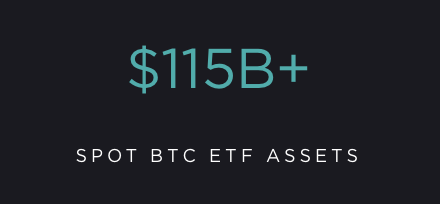
Spot bitcoin ETFs now manage over $115 billion in combined assets. Public companies collectively hold over 1.7 million BTC – roughly 8% of total supply. Strategy alone holds 762,099 coins. By late 2025, roughly 200 public companies worldwide held bitcoin on their balance sheets, nearly three times more than the year before.
But the number that captures the flip best is this: Morgan Stanley's wealth management platform oversees around $5.5 trillion in client assets. Its advisers can now allocate up to 4% of a client's portfolio to bitcoin. Even a modest 2% allocation across that base could represent $110 billion in new demand – from a single institution.
Now multiply that by every bank, pension fund, and family office having the same conversation. This isn't a speculative frenzy. It's portfolio construction. It's risk management. It's the most boring, institutional reason imaginable to buy bitcoin – and that's exactly why it matters.
|
|
|
The Loop That Locks It In
Here's the part that most analysis misses. The flip isn't just a one-time shift – it's a self-reinforcing loop.
More companies buy bitcoin. MSCI decides not to penalise them. That means more index funds hold their shares. More index fund exposure means more analysts cover bitcoin-holding companies. More coverage normalises bitcoin on the balance sheet. More normalisation makes the next treasurer's job easier when they pitch it to their board.
Meanwhile, fair-value accounting means companies can now report bitcoin gains, not just impairments. So the asset looks better on the books. So more companies buy it. So more get included in indices. And the loop tightens.
This is how phase transitions work. Slowly, then all at once. Each piece of infrastructure makes the next adoption step easier, cheaper, and harder to argue against. At some point – and we may already be past it – the loop becomes the default.
|
| |
Bitcoin didn't become less risky. Everything else became more risky. And eventually, the spreadsheets caught up.
|
|
|
|
What This Means for Kiwi Stackers
If you've been stacking sats from Aotearoa while the rest of the financial world was still debating whether bitcoin was real, you already know what the institutions are only now discovering.
The flip doesn't change your strategy. You were already here. What it does change is the environment around you. The rails are being built. The gatekeepers are stepping aside. The language is shifting from "speculative" to "strategic" to "prudent."
Larry Fink didn't start a bitcoin ETF because he read the whitepaper and had a philosophical awakening. He did it because his clients were asking for it, and his risk team couldn't find a good reason to say no anymore. Vanguard didn't reverse its stance because Jack Bogle's ghost appeared and said "number go up." It reversed because excluding bitcoin from its platform was starting to look like the bigger risk.
That's the quiet flip. Not a revolution. Not a victory lap. Just a slow, systematic recalculation by the world's most conservative financial institutions, all arriving at the same conclusion: in a world of unlimited money and unlimited debt, the asset with a hard cap of 21 million isn't the risky bet. It's the hedge.
|
|
Stack accordingly,
Simon
|
|
|