|
|
The $305,000 Question
|
|
What does it actually cost to mine a bitcoin — and what does that tell us about energy, sovereignty, and risk?
|
|
By the Lightning Pay team · March 2026
|
|
|
|
|
|
Hey stackers,
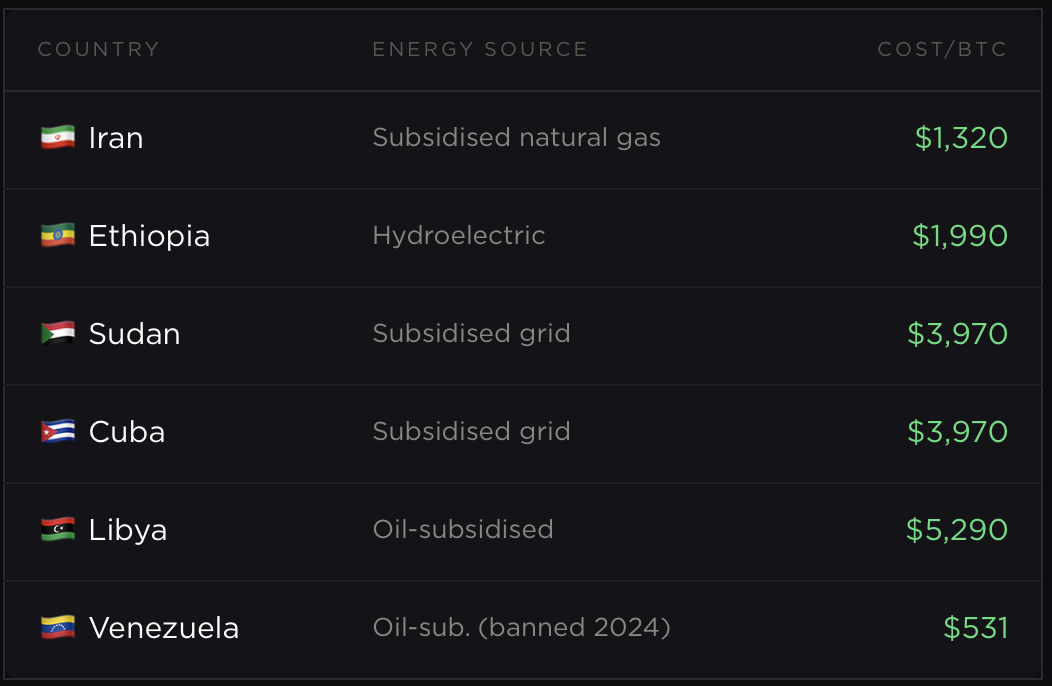
Here’s a thought experiment: take two identical ASIC miners, plug one into a wall socket in Tehran and the other into a wall socket in Milan. Same machine, same hash rate, same difficulty adjustment, same block reward. The Tehran rig produces a bitcoin for roughly $1,320 in electricity. The Milan rig? About $306,550.
That’s a 230x difference for the exact same output. One is an 83x return on energy. The other is a guaranteed way to go bankrupt. Same protocol, same rules, same ten-minute block time – radically different economics.
This week, let’s pull apart the global mining cost map, because it tells us something profound about Bitcoin’s relationship with energy, sovereignty, and risk.
|
The Cheap Seats
The cheapest countries to mine bitcoin are dominated by nations with heavily subsidised or underdeveloped energy markets. These aren’t Silicon Valley startups optimising for efficiency – they’re geopolitical anomalies where broken economics happen to produce absurdly cheap electricity.
|
| Country |
Energy Source |
Cost/BTC |
| 🇮🇷 Iran |
Subsidised natural gas |
$1,320 |
| 🇪🇹 Ethiopia |
Hydroelectric |
$1,990 |
| 🇸🇩 Sudan |
Subsidised grid |
$3,970 |
| 🇨🇺 Cuba |
Subsidised grid |
$3,970 |
| 🇱🇾 Libya |
Oil-subsidised |
$5,290 |
| 🇻🇪 Venezuela |
Oil-sub. (banned 2024) |
$531 |
|
|
Iran is the poster child. The government provides industrial electricity at rates as low as $0.005 per kWh – essentially free by Western standards. Tehran legalised mining in 2019 specifically to generate foreign currency and circumvent international sanctions. But the sector is deeply split: licensed miners must sell their entire yield to the Central Bank, while an estimated 90% of mining occurs underground – operators hiding rigs in schools, mosques, and rural farms, risking raids, jail time, and equipment seizure.
Ethiopia is one of the fastest-growing mining markets, capitalising on massive underutilised hydroelectric capacity. The government sees bitcoin mining as a way to monetise surplus energy via compute. Growth has been rapid, but political instability and intermittent civil conflict create serious long-term operational risk.
Venezuela is the wildcard. It technically had the cheapest mining costs on earth, but the government banned mining in May 2024, seizing thousands of ASIC machines – even while the Maduro regime was reportedly accumulating bitcoin through oil-for-USDT swaps. The grid is also notoriously unreliable, with frequent blackouts making consistent operations nearly impossible.
|
| |
The cheapest places to mine bitcoin are cheap precisely because something else is broken.
|
|
The Nosebleed Section
At the other end of the spectrum, the cost to mine a single bitcoin exceeds the price of a house – and in some cases, several houses.
|
| Country |
Cost/BTC |
vs. Price |
| 🇮🇪 Ireland |
$321,000 |
~3.7x |
| 🇮🇹 Italy |
$306,550 |
~3.5x |
| 🇧🇸 Bahamas |
$280,000 |
~3.2x |
| 🇦🇹 Austria |
$277,000 |
~3.2x |
| 🇨🇭 Switzerland |
$236,000 |
~2.7x |
| 🇩🇪 Germany |
$163,000 |
~1.9x |
| 🇺🇸 United States (avg) |
$102,260 |
~1.2x |
|
|
Italy tops the global list, driven by high electricity tariffs, dependence on imported energy, and stringent environmental regulation. The average household energy price to mine one bitcoin in Europe sits around $85,700 – compared to just over $20,000 in Asia. Europe has effectively priced itself out of participating in securing the Bitcoin network.
The United States is more nuanced. The national average sounds painful, but large-scale operators in Texas, Kentucky, and Wyoming negotiate bulk deals, tap stranded natural gas, or run on renewables. The US currently accounts for roughly 37.5% of global hashrate – about 400 EH/s – making it by far the dominant player.
|
|
|
The Hidden Cost of Cheap
Cheap mining is not free mining. The countries at the bottom of the cost curve almost universally come with a hidden price tag. For every dollar saved on energy, there’s often a corresponding increase in political, legal, or operational risk.
|
|
⚖️ Seizure & Legal Risk
|
|
In Iran, miners regularly face equipment seizures during government raids aimed at stabilising the power grid. Operational risks include jail time and asset forfeiture. An 83x return doesn’t mean much if your rigs are in a government warehouse.
|
|
🚫 Sanctions Exposure
|
|
Iran and Venezuela use bitcoin mining as a sanctions evasion tool. Any bitcoin from these operations carries serious compliance risk. Chainalysis identified $44.6 billion in crypto flows in Venezuela through 2025, much intertwined with state-directed evasion.
|
|
⚡ Grid Fragility
|
|
The subsidies that make mining cheap often strain already fragile grids. Iran repeatedly shuts down legal mining during demand peaks. Venezuela suffers chronic blackouts. Cheap power you can’t reliably access isn’t cheap – it’s imaginary.
|
|
🔥 Political Instability
|
|
Ethiopia faces ongoing civil conflict. Sudan is in a devastating war. Venezuela just went through a regime change. These aren’t jurisdictions where you ship half a million dollars of ASICs and sleep well at night.
|
|
🔄 Regulatory Whiplash
|
|
Venezuela banned mining in May 2024 and seized thousands of machines – while the state was allegedly building a bitcoin reserve through oil-for-USDT swaps. When the government is your biggest competitor and your regulator, the rules change overnight.
|
|
|
|
What the Cost Map Really Tells Us
Bitcoin mining cost maps are really energy policy maps. And energy policy maps are really geopolitics maps.
The cheapest places to mine are cheap precisely because something else is broken: subsidies propping up authoritarian regimes, sanctions creating perverse incentives, or infrastructure too fragile to properly price its own energy. The most expensive places have priced themselves out of network security entirely. And in the middle, the US has threaded the needle with institutional capital, smart energy sourcing, and enough regulatory clarity to attract the lion’s share of global hashrate.
This cost distribution also creates a natural price floor. Mining production costs act as a decentralised circuit breaker. If bitcoin’s price fell below $20,000, a huge portion of miners would go underwater. They’d shut down, difficulty would adjust, and the survivors become more profitable. The protocol heals itself – no central bank required, no emergency committee, no bailout. Just thermodynamics and game theory.
|
| |
Bitcoin doesn’t care where it’s mined. One hash in Tehran is the same as one hash in Texas. The protocol is perfectly indifferent. But the humans running the machines are not.
|
|
|
The 230x cost spread between Iran and Italy tells you everything about how energy policy shapes who gets to participate in the hardest money ever created. It tells you which governments see bitcoin as a lifeline, which see it as a threat, and which have simply priced themselves out of the conversation.
For those of us simply stacking sats from the comfort of Aotearoa, none of this changes the playbook. We don’t need cheap electricity or political connections. We just need conviction, consistency, and a time horizon measured in years rather than news cycles.
The miners fight over production costs. We just accumulate the output.
|
|
Stack accordingly,
The Lightning Pay Team
|
|
|
|