

Proof of Light
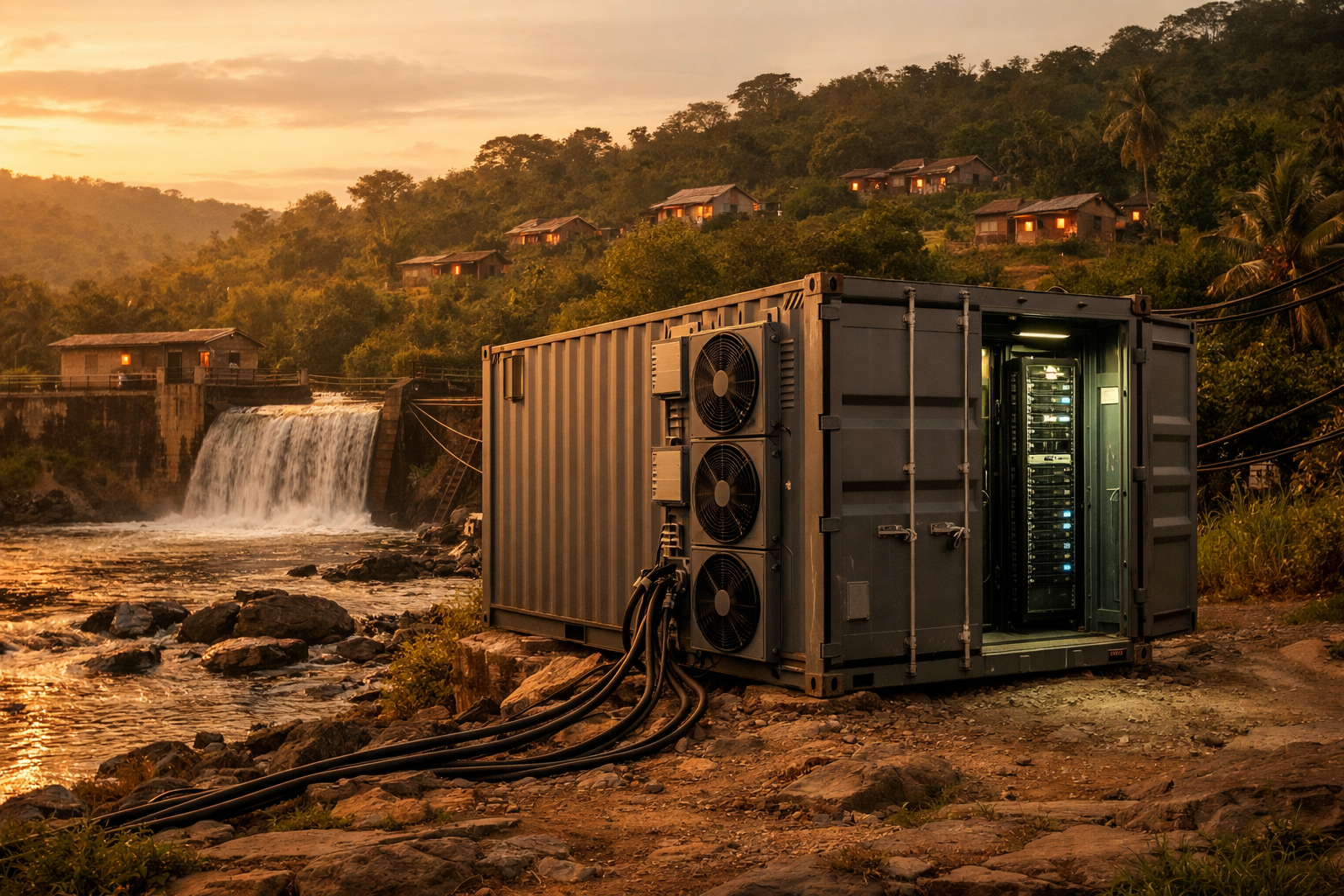
How Bitcoin mining is bringing electricity to communities that have never had it - and why the "Bitcoin wastes energy" narrative has it backwards.
7 April 2026 · 8 min read

You've heard the line. You've probably been on the receiving end of it at a barbecue. "Bitcoin uses more electricity than entire countries." It's the go-to criticism - the one that even your mum's heard. And look, it's not wrong. The Bitcoin network does consume a lot of energy. About 138 terawatt hours a year, or roughly 0.5% of global electricity production.
But here's what the critics never mention: that energy consumption is bringing electricity to people who have never had it. Not through charity. Not through government aid. Through pure market incentives.
This is the story of how a shipping container full of mining rigs, parked next to a river in rural Malawi, is doing more for electrification than decades of development programmes. And it's not just one container. It's a global movement.
The problem nobody could solve
Nearly 600 million people in Africa lack access to electricity - a staggering energy crisis concentrated in Sub-Saharan Africa, where roughly 53% of the population lives without power. The big cities are connected. Nairobi has power. Mombasa has power. But venture into rural Africa and you'll find communities that have never seen a light switch.
The solution, in theory, is mini-grids - small-scale renewable energy installations (typically 20kW to 1MW) that serve localised communities independently from the national grid. Hydro from a nearby river. Solar panels. Small wind turbines. The technology works. The problem is economics.
A mini-grid developer builds a hydro plant that can generate, say, 200 kilowatts. But the village it serves might only use 50 kilowatts at peak - and even that demand comes in two short bursts, 6-8am and 6-9pm, with almost nothing in between. The remaining 150 kilowatts earns precisely zero revenue. The plant runs at a fraction of capacity. The returns are terrible. Investors won't fund it.
According to the Green Africa Mining Alliance, the number of mini-grids in Africa needs to grow from about 3,100 to 160,000 by 2030 - requiring $91 billion in investment. At current rates of development, they'll hit maybe 44,800. The maths simply doesn't work without subsidies or charity.
Or so everyone thought.
|
600M
People in Africa without access to electricity
|
160K
Mini-grids needed by 2030
|
|
$91B
Investment required
|
20-80%
Surplus energy wasted on typical mini-grids
|
Enter the buyer of last resort
Bitcoin mining has three properties that make it unique among industrial energy consumers. First, it's geography-agnostic - unlike aluminium smelting or data centres serving latency-sensitive customers, a miner can operate literally anywhere there's power and an internet connection. Second, it's interruptible - miners can throttle from full power to zero in seconds, with no damage, no downtime penalties, no supply chain disruption. Third, it runs 24/7/365 - it never sleeps, never takes holidays, never decides it doesn't fancy buying electricity today.
That combination makes Bitcoin mining the perfect anchor tenant for a struggling mini-grid. It buys the energy nobody else wants, when nobody else wants it. And when the community needs power - when the clinic fires up, when a welder starts work, when kids come home from school and turn on the lights - the miners step back. Instantly. Automatically.
The result: the energy developer finally has a customer for their surplus. Revenue flows. The plant becomes financially viable. And because the economics now work, electricity tariffs for the community can actually come down.
|
💧
|
Renewable energy source A hydro, solar, or geothermal plant generates power - but the village can only use a fraction of it |
| ↓ | |
|
⛏️
|
Bitcoin miners absorb the surplus A shipping container of miners co-locates with the plant, buying excess energy and converting it to Bitcoin |
| ↓ | |
|
⚡
|
Smart demand response Software monitors grid load in real time - miners throttle down instantly when community demand rises |
| ↓ | |
|
💡
|
Community gets cheaper power Mining revenue subsidises the grid. Tariffs drop. More households connect. The plant expands its reach |
When community demand peaks in the evening, miners throttle down instantly.
The rest of the time, they monetise every watt the grid can produce.
Gridless: the poster child
The most visible example of this model is Gridless Compute, a Kenyan company founded in 2022 by Erik Hersman, Philip Walton, and Janet Maingi. Backed by Jack Dorsey's Block and venture firm Stillmark, Gridless now operates seven mining sites across Kenya, Malawi, and Zambia.
The model is elegant. Gridless partners with small-scale renewable energy producers - typically run-of-river hydro plants - and co-locates a mining container at the generation site. Their proprietary software, Gridless OS, runs on a ruggedised edge server inside the container and manages real-time demand response, coordinating miners with the grid's operating parameters second by second.

The results speak for themselves. In Murang'a County, Kenya, electricity costs for the local community dropped from $10 per month to $4 - a 60% reduction. At one pilot site, the hydro plant dropped its tariff from 35 cents per kilowatt hour to 25 cents. Across their operations, Gridless has powered approximately 5,000 houses in Kenya, 1,800 in Malawi, and 1,200 in Zambia.
Beyond the lights, Gridless sites have enabled containerised cold storage for local farmers, battery charging stations for electric motorcycles, and public WiFi points. The mining containers themselves are now designed and built in Kenya using locally sourced materials - Gridless even open-sourced their "Kifaru" (Swahili for rhino) container blueprints so other operators can build their own.
"About 600 million Africans have no access to electricity. We at Gridless come in and say - that electricity you're not able to send to anyone? That's what we want."
Janet Maingi, Co-Founder, Gridless ComputeBut Gridless aren't doing this alone. They're a founding member of the Green Africa Mining Alliance (GAMA), an industry body established in 2022 to share knowledge and support new miners across the continent. And the movement stretches well beyond Kenya.
A continent lighting up
The micro-grid mining model is spreading across Africa and beyond, with projects at varying scales but united by the same core thesis: Bitcoin turns stranded energy into revenue, and that revenue funds electrification.

The bigger thesis
Step back from the individual projects and a powerful thesis emerges. Bitcoin doesn't consume energy in the way its critics suggest. It monetises energy. Specifically, it monetises energy that would otherwise have zero economic value - surplus generation from mini-grids, stranded hydro capacity, curtailed solar output.
A peer-reviewed paper from January 2023 put numbers to this. Researchers modelled what would happen if Bitcoin mining was integrated with solar micro-grids globally, and found it could boost project profitability by up to 125% by reducing curtailment losses. Another study framed mining loads as "virtual energy storage" - instead of storing surplus electrons in expensive batteries, you store them as Bitcoin.
The academic phrase for what miners do on a mini-grid is "productive use of energy" (PUE). It's not a new concept in development economics - the idea that energy access alone isn't enough; you need productive demand to make energy investments sustainable. What's new is that Bitcoin provides the most flexible, location-agnostic, instantly-deployable PUE the world has ever seen.
Bitcoin miners serve three roles simultaneously on a mini-grid: buyer of first resort (purchasing energy when there's no other demand), buyer of last resort (buying when nobody else has use for it), and grid balancer (providing real-time demand response to keep the grid stable). No other industrial load can do all three.
And here's where it gets truly interesting. As community demand grows over time - as more households connect, as businesses spring up, as the local economy develops - the mining load can gracefully scale down, freeing up capacity for the humans who need it. The miners aren't competing with the community. They're the scaffolding that makes the whole structure possible, and they step aside as the building takes shape.
What does this mean for Kiwis?
Aotearoa runs on roughly 80-85% renewable electricity - overwhelmingly hydro, with healthy contributions from geothermal, wind, and solar. We know what stranded renewable energy looks like. The South Island regularly generates more hydro than it can consume or transmit north.
The same principle that lights up a Malawian village applies here, just at different scale and for different reasons. Bitcoin mining as a flexible, interruptible load that absorbs surplus generation and steps back during peak demand isn't just an African story. It's a universal energy story. And for a country that's already blessed with abundant renewables, it's an opportunity hiding in plain sight.
The line worth remembering
Alex Gladstein of the Human Rights Foundation spent time in Bondo, Malawi, visiting one of the communities that Gridless operations have connected to power. He described pausing one evening as the sun went down and looking at the hills around him - watching the lights turn on, all across the foothills of Mount Mulanje.
Those lights exist because Bitcoin mining made a micro-hydro plant financially viable. Not aid. Not charity. Not a government programme. A decentralised, open-source software network, with no known inventor and controlled by no company or government, provided the economic incentive that turned wasted electrons into the first reliable power many of those families had ever known.
So next time someone tells you Bitcoin wastes energy, you might ask them: compared to what? Compared to those electrons vanishing into nothing while nearly 600 million people sit in the dark?
Bitcoin doesn't waste energy. It gives energy a reason to exist.
Stack accordingly. ⚡
Simon Co-Founder, Stacked