|
Edition 3 |
|
| Monday, 20 April 2026 |
Are we the baddies?
|

|
| Iran proposed accepting Bitcoin for Hormuz tolls. Before we panic about who uses uncensorable money, it's worth asking who built the censored version in the first place. |
|
|
|
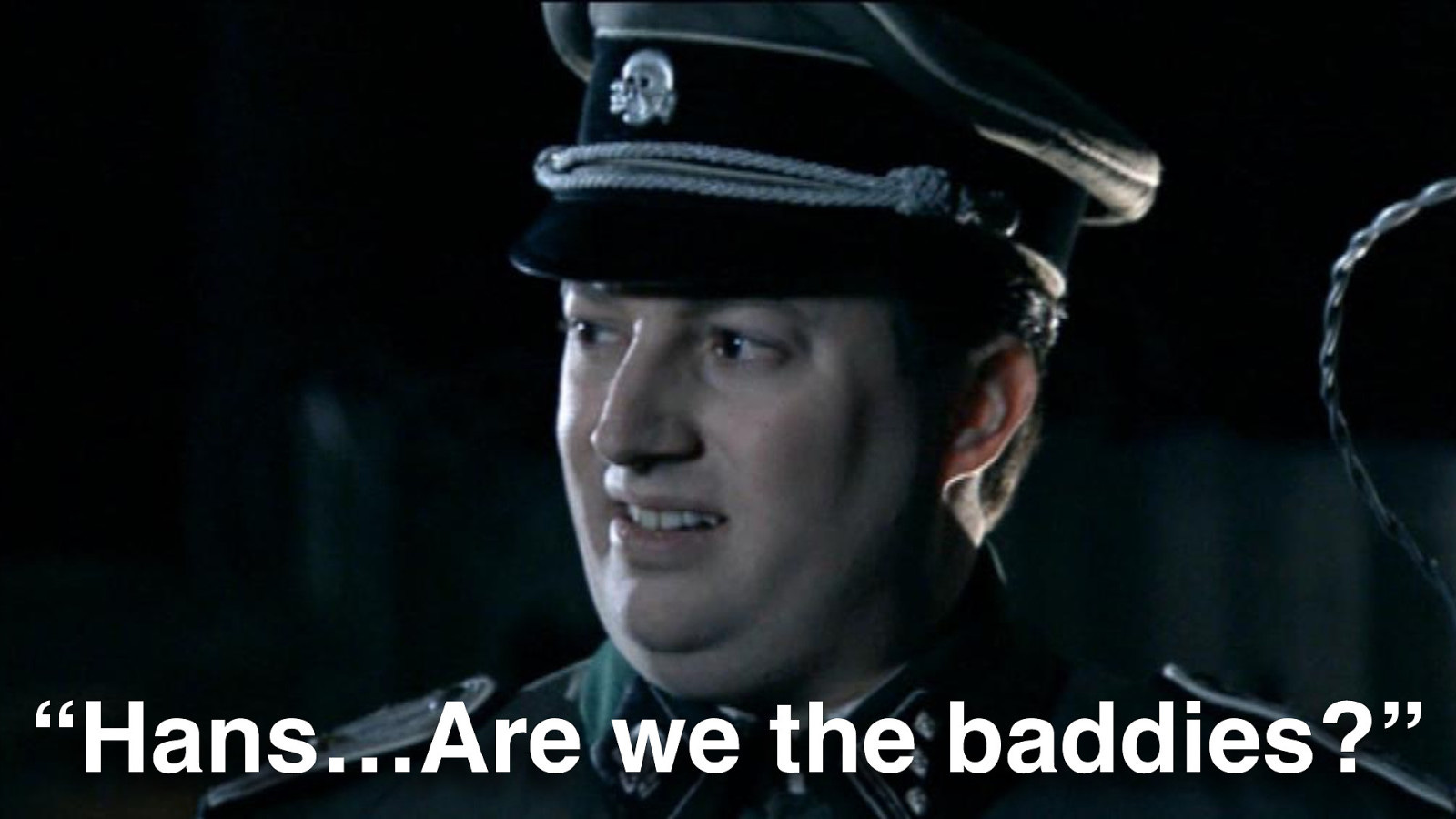
There's a famous Mitchell and Webb sketch where two SS officers, sitting in a trench in their black uniforms with skull insignia, slowly realise something awkward. "Hans," one says, glancing at his cap badge, "are we the baddies?"
It's a question worth asking of ourselves. In early April, a spokesperson for Iran's Oil, Gas and Petrochemical Products Exporters' Union told the Financial Times that Iran was proposing to charge tankers passing through the Strait of Hormuz a toll of roughly $1 per barrel, payable in Bitcoin. A fully loaded supertanker would face a bill approaching $2 million. The rationale, according to Iran, was that Bitcoin payments "can't be traced or confiscated due to sanctions."
That's a headline that should make any Bitcoiner pause. If an autocratic theocracy is proposing to use your favourite monetary network to route around sanctions, are you, in some small way, holding the bag for the baddies?
The honest answer is: this question has been asked before. And the question itself rests on a premise worth examining - that money should come with a conscience, and that somebody, somewhere, should be empowered to decide who gets to use it.
|
A brief history of money as a surveillance instrument
|
|
For most of human history, money didn't know who you were. A coin in a pocket, a note in a drawer, a ledger in a village - these were tools of exchange, not tools of observation. A transaction was a transaction. What changed this, at scale, was a piece of American legislation signed on October 26, 1970 by President Richard Nixon: the Bank Secrecy Act.
The BSA required US financial institutions to keep records of cash purchases, file reports on any transaction above $10,000, and flag "suspicious activity" to the federal government. It was sold as an anti-money-laundering measure. What it actually did was conscript the banking system into a government surveillance apparatus. The $10,000 threshold, notably, has never been adjusted for inflation - in 1970 it was enough to buy two Corvettes. Today it wouldn't cover 15% of one.
The Supreme Court knew this was a problem. In 1974, Justices Powell and Blackmun warned that expanding the reporting requirements would "pose substantial and difficult constitutional questions" and that "governmental intrusion upon these areas would implicate legitimate expectations of privacy."
They didn't stop it. And the machine grew.
|
|
What's a SAR?
A Suspicious Activity Report is a confidential filing your bank sends to the government when it thinks something about your account looks "suspicious" - a word the regulations deliberately leave vague.
You are not told when one is filed about you. Your bank is legally prohibited from telling you. You cannot see what it says, challenge it, or correct it. In fiscal year 2024, US financial institutions filed 4.7 million of them.
|
|
|
In 1986, Reagan signed the Money Laundering Control Act, making money laundering a federal crime and criminalising "structuring" - breaking deposits up to stay below the threshold. In 1990, FinCEN was created. In 2001, the PATRIOT Act mandated formal AML programmes at every financial institution. And the reports multiplied.
The trajectory is best told in a single chart.
|
|
Chart 1
Suspicious Activity Reports filed annually (US)
From 62,000 in 1996 to 4,700,000 in 2024
| 1996 |
|
| 2003 |
|
| 2010 |
|
| 2017 |
|
| 2022 |
|
| 2024 |
|
Source: FinCEN annual reports. Bar widths proportional to scale for visual reference.
|
|
|
4.7M
SARs filed in FY2024
|
|
|
20M+
CTRs filed in FY2024
|
|
|
$10K
Threshold, unchanged since 1970
|
|
|
|
That is not a crime-fighting regime. That is a bulk surveillance dragnet. The US banking system has been turned into an eyes-and-ears network reporting back to the state, and - because the US exports its financial regulations through correspondent banking - so has most of the rest of the world's, including New Zealand's.
|
| "Governmental intrusion upon these areas would implicate legitimate expectations of privacy."
— Justices Powell and Blackmun, US Supreme Court, 1974
|
|
And then there's the list
|
|
The surveillance is one half of it. The other half is the list.
The Office of Foreign Assets Control maintains the Specially Designated Nationals list - a registry of individuals and entities that US persons are prohibited from transacting with. Because of the dollar's role as the global reserve currency and the reach of correspondent banking, being on the SDN list effectively locks you out of the global financial system.
The list now contains tens of thousands of names. In 2024 alone, the United States issued more new sanctions designations than all other major sanctioning jurisdictions combined.
|
|
Chart 2
New OFAC sanctions designations by year
Approximate new SDN additions per year
Source: CNAS, Castellum.AI sanctions tracking. Figures are approximate annual new designations.
|
|
|
Who decides who goes on the list? A small number of officials in the US Treasury. There is no trial. There is no jury. There is a process for appeal, but the burden of proof sits with the person trying to get off, not the government that put them on. You can be frozen out of your bank, your credit cards, and the entire global dollar system on the say-so of an unelected committee.
Sometimes the people on the list deserve to be there. Often they do not. Ordinary Afghans found their central bank's reserves frozen when the Taliban took Kabul in 2021. Russian citizens with no political connection to the invasion of Ukraine found themselves locked out of international payments in 2022. Canadian truckers had their bank accounts frozen during the 2022 convoy protests - not by OFAC, but using the same playbook. Nigerian protesters in 2020. Greek pensioners in 2015. The pattern repeats.
|
Why uncensorable money is a necessary good
|
|
Once you understand that the modern financial system is a surveillance and exclusion apparatus dressed up as a payment network, the question of who uses Bitcoin reframes itself.
The ability of any single authority to freeze you out of the economy is a feature when it's aimed at people we don't like. It's a catastrophe when it's aimed at someone we do - or at us. And we don't get to choose. The institutions that decide who is permitted to hold money today do not answer to you, and there is no reason to assume they will always decide in your favour.
Bitcoin is a response to this. A monetary system that cannot be censored, frozen, or selectively revoked is not a convenience for criminals - it is a structural correction to three centuries of concentrating monetary authority in the hands of the few. The fact that it sometimes gets used by people we consider bad is not a flaw in the design. It is the unavoidable cost of a property that is extraordinarily valuable: that the system works the same for everyone.
A Bitcoin that only worked for people the US State Department approved of would be a worse, slower version of the dollar. Its entire value proposition is that it makes no such distinctions.
|
The Iran case, specifically
|
|
Worth noting: Iran is a relatively weak example for those arguing Bitcoin is "on the wrong side." The proposal was from an industry spokesperson, not a formal policy announcement. It's unclear whether the toll is actually being collected in Bitcoin today, or whether it ever really was.
Separately, Chainalysis has noted that the IRGC's actual high-volume illicit payment flows run mostly through stablecoins, not Bitcoin - because every Bitcoin transaction is recorded on a public ledger, forever. Bitcoin is a remarkably poor tool for genuine sanctions evasion at scale. You can read a tanker's manifest and match it to on-chain activity in minutes.
If Iran wanted to hide, they'd use cash, stablecoins, or gold. They named Bitcoin because it's politically neutral, not because it's opaque.
|
So, are we the baddies?
|
|
No.
The baddies are the people who decided, in 1970 and every year since, that your financial activity is the government's business by default. The baddies are the people who built a surveillance machine large enough to process 25 million reports a year on ordinary citizens. The baddies are the people who maintain a list of tens of thousands of names that can exclude you from global commerce with no trial, and who add to that list faster than anyone else on Earth.
Uncensorable money is how you opt out of that. The fact that Iran might use it too is not an argument against it. It's a reminder that once you build a tool that works for everyone, it works for everyone - and that is precisely the point.
|
|
Stack accordingly,
Simon
|
| |
|