

Bitcoin Lightning Wallets
How to choose the one that's right for you.
Written by Brandon - Stacked Team
Updated: June 2026
What is a Bitcoin Lightning Wallet?
A Bitcoin Lightning wallet is a software that allows you to transact and view your bitcoin balance on the Bitcoin Lightning network.
These tools come in many shapes, sizes and flavours. Below, we do our best to discuss the various tradeoffs inherent to different kinds of wallets, and close with some general recommendations. Keep in mind, some of these will not be compatible with some Stacked services, so check out our wallet compatibility article as well.
Before we begin, because the fees for transactions on the Bitcoin Lightning network are generally inexpensive (with some caveats, see below), we encourage you to try out many of these tools to find out which is right for you.
Our General Framework
Classifying these wallets is difficult, and there are many to choose from. To be considered here, a wallet must have a few key criteria met.
- Its main use case is compatible with the Bitcoin Lightning Network for sending payments.
- It isn't in early development, and is freely available to use.
- We aren't including software that is purpose built for managing your own infrastructure. A lot these will work as wallets, even very good ones, but this is too advanced for our purposes here.
- There are way too many wallets to cover them all. We're taking some editorial license to cover only those we think have significant market share, or interesting features.
Because the picture of Lightning Wallets has become a bit more variable over the past year or so, we're broadly creating 3 categories of wallet for you to consider. This revision of our overview article will consider that many wallets now have a lot of flexibility, and thus require consideration in multiple categories. The reason why will be explained in the description.
Custody
When choosing a Lightning wallet, the most important distinction is custody — in other words, who ultimately controls the bitcoin.
At a high level, wallets fall into several custody models. These models differ in how trust is distributed, how funds are held when not being spent, and what assumptions the user must make about third parties. None of these models are inherently “right” or “wrong”; each reflects a different set of tradeoffs.
Broadly, Lightning wallets today fall into the following categories:
Custodial
A third party fully controls the bitcoin and Lightning infrastructure on your behalf. These wallets behave much like a traditional account: you are shown a balance and can send and receive payments, but the underlying bitcoin is held by the provider.
Private Custodial (Cashu)
A specialised form of custodial wallet based on the Cashu protocol. Bitcoin is still held by a custodian, but cryptographic techniques are used to limit what the custodian can learn about user balances and transactions, offering strong privacy with a simple user experience.
Federated Custody
Bitcoin is controlled by a group of independent parties (a federation), typically using multisignature arrangements. Users hold an asset that represents a claim on the bitcoin held by the federation. This model aims to reduce reliance on any single custodian while remaining interoperable with Lightning.
Delegated Self-Custody
Users control their own bitcoin keys, but rely on shared infrastructure to coordinate Lightning payments. Bitcoin is self-custodied on-chain, while Lightning functionality is provided through cooperative systems that reduce the need for users to manage channels and liquidity directly.
Advanced Self-Custody
Fully self-custodial wallets where users retain complete control over their bitcoin and Lightning setup. These wallets typically offer powerful features and flexibility, but require greater understanding and responsibility from the user.
The rest of this guide uses these custody models as its primary structure, with examples and tradeoffs explored within each category.
User Experience
User experience in Lightning wallets is often misunderstood.
The Lightning Network itself is complex: payments depend on liquidity, routing, fees, and online infrastructure. A wallet’s user experience is defined not by how this system works internally, but by how much of that complexity the wallet exposes to the user.
Some wallets are designed so that Lightning “just works,” hiding nearly all operational details. Others give users more visibility or control, which can improve privacy or flexibility but requires more attention and understanding.
Importantly, user experience and custody are no longer tightly coupled. In the past, good UX usually meant giving up custody. Today, advances in wallet design mean that strong UX exists across multiple custody models — including self-custodial ones.
Instead of ranking wallets by how “easy” or “advanced” they are, this guide focuses on:
-
What responsibilities the user takes on
-
What tradeoffs exist around reliability, privacy, and recovery
-
How forgiving the wallet is when things go wrong
As you move through the categories below, you’ll see how different custody models shape the user experience — not as a hierarchy, but as a set of design choices suited to different needs and comfort levels.
Privacy
Privacy is an important consideration when choosing a Lightning wallet, but it comes with tradeoffs.
In general, privacy depends on who can observe your activity and how much control the wallet provider has over payments and infrastructure. Wallets that manage custody, liquidity, or routing on your behalf can usually see more about how the wallet is used. This doesn’t imply bad intent — it’s often necessary to provide a reliable and simple experience.
Other wallet designs reduce this visibility by separating custody from payment coordination, or by using cryptographic techniques to limit what intermediaries can learn. These approaches can meaningfully improve privacy, but may introduce additional fees, constraints, or complexity.
At the most privacy-focused end, wallets minimise third-party visibility as much as possible. These designs offer strong privacy properties, but typically require users to accept more risk, responsibility and less automation.
In this guide, privacy reflects relative tradeoffs between usability, reliability, and information exposure, rather than absolute anonymity. The right choice depends on how much privacy you want, and what complexity you’re comfortable with.
Costs and Fees
While the fees for payments on the Lightning Network are generally very inexpensive, because the Lightning Network is tied to Bitcoin Network transactions, costs can still be a consideration, depending on the wallet you choose.
Normal transaction fees for regular payments in almost every wallet will be inconsequential. However, if you are using a wallet that tries to keep as much control in the user's hands as possible, you may encounter costs when your payment channels do not have the liquidity required to make the requested payment.
We will note those where the user must be aware of the fees that may come from channels being opened to their self-custody wallet. Generally, all self custody wallets will come with added fees, but the hybrid wallets can lower this to some degree.
Lightning Wallet Breakdown
The sections below introduce the main categories of Lightning wallets you’ll encounter today. Each category reflects a different set of tradeoffs across custody, user experience, privacy, and fees.
The diagrams that follow are intended to give a high-level overview of where each wallet type generally sits. They are not rankings, but visual aids to help you narrow down which designs are likely to suit your needs.
Custodial Lightning Wallets
These wallets prioritise simplicity and reliability above all else. From a user’s perspective, they behave much like a traditional payments app: you have a balance, payments usually work instantly, and very little configuration is required.
Because the wallet provider manages custody and Lightning infrastructure, these wallets tend to offer a smooth user experience and the most predictable behaviour for everyday payments. Fees are typically straightforward, and recovery is often handled by the provider.
The tradeoff is reduced control and limited privacy compared to other models. These wallets are best suited to users who are just getting started, experimenting with small amounts, or who value convenience over self-custody.
If you want to take a deeper dive, we have more coverage of the tradeoffs presented to users by Custodial Lightning Wallets.
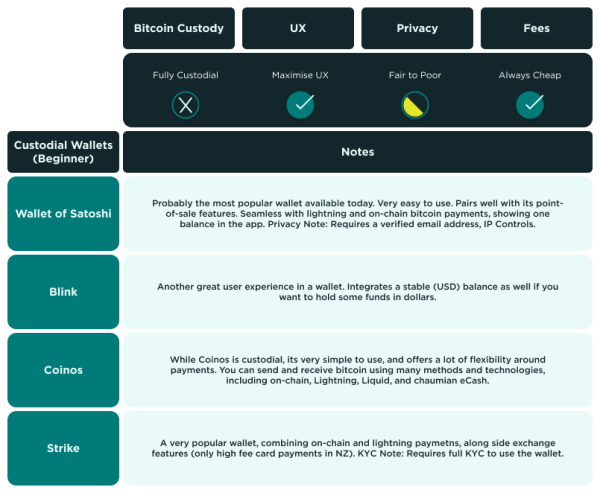
Explore wallets in this category:
Private Custodial
Private custodial wallets are built on the Cashu protocol and represent a newer design space within Lightning wallets.
These wallets retain a custodial model, but use cryptographic techniques to significantly reduce what the custodian can observe about user balances and transactions. This allows for strong privacy, advanced payment features, and in some cases offline or delayed payments.
From a user experience perspective, Cashu wallets often feel as simple as traditional custodial wallets, while offering meaningfully improved privacy. Users should still be aware that custody risk exists, and trust is placed in the chosen mint.
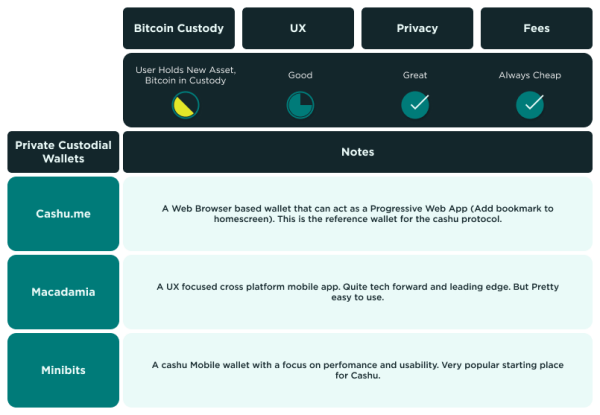
Explore wallets in this category:
Federated Custody
Federated custody wallets distribute trust across a group of custodians rather than relying on a single entity. These custodians may be individuals, organisations, or community members, depending on the wallet.
Instead of holding bitcoin directly, users control an asset that represents a claim on bitcoin held by the federation, such as Liquid Bitcoin or eCash. This design aims to reduce single points of failure while remaining interoperable with Lightning.
Federated custody wallets often represent a middle ground, offering improved resilience, privacy, or user experience compared to traditional custodial wallets, while avoiding the full complexity of self-custody.

Explore wallets in this category:
Delegated Self-Custody
Delegated self-custody wallets are built on newer technologies that allow users to retain control of their bitcoin keys while delegating much of the operational complexity required for Lightning payments.
In these designs, bitcoin remains self-custodied on-chain, while shared infrastructure coordinates Lightning payments and abstracts away most channel and liquidity management. This results in an excellent balance between usability and control.
These wallets typically offer strong security properties and a polished user experience, with lower ongoing fees than fully managed custody models. The main tradeoff is that users must still securely manage their keys, and recovery may be less forgiving than custodial options.
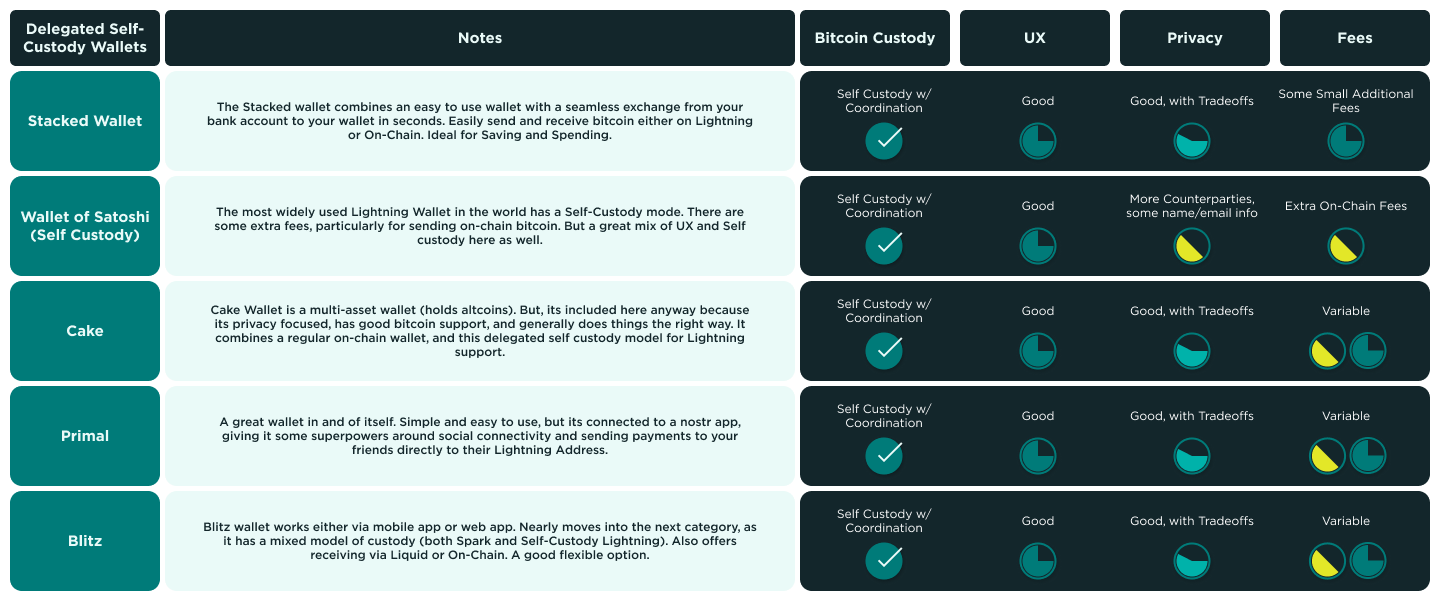
Explore wallets in this category:
Self-Custody Lightning
Fully self-custodial Lightning wallets give users complete control over their bitcoin and Lightning setup, exposing more of the underlying mechanics than other wallet types.
These wallets offer advanced features and flexibility, but come with increased responsibility. Users may encounter higher or less predictable fees, more complex recovery processes, and a steeper learning curve.
Self-custody Lightning wallets are best suited to users who already understand bitcoin self-custody and are comfortable managing the additional complexity in exchange for maximum control.
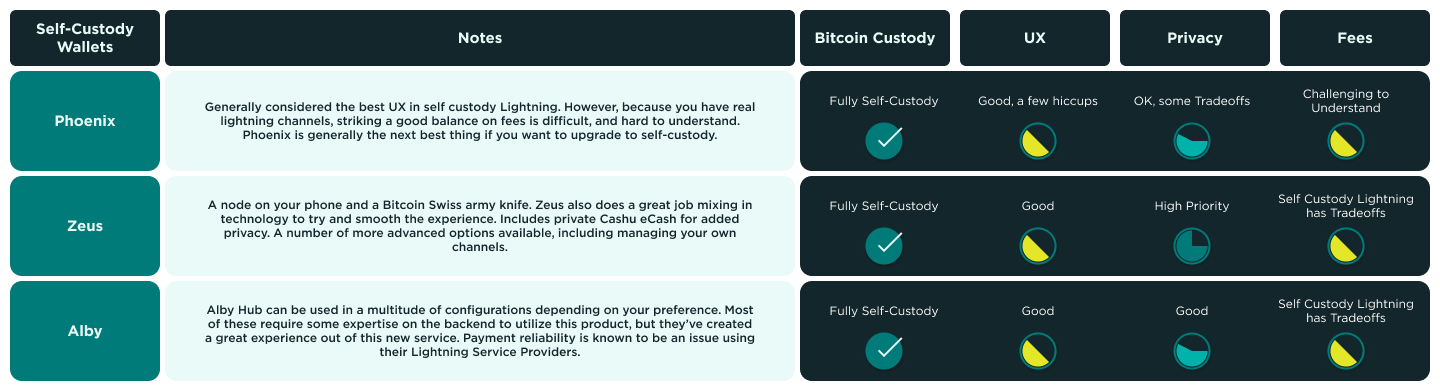
Explore wallets in this category:
Conclusion
The list above contains only the most popular Bitcoin Lightning Wallets available, there are many more to choose from, and an endless number of options. Luckily, with fees so low, there is no harm in giving a new wallet a try to find your preference.
There are new technologies and features being added to wallets regularly. We will do our best to keep this article up to date, but things move fast in Bitcoin. Lastly, be sure to check out our “Supported Wallets” article, as some of these wallets won’t be compatible with Lightning Network withdrawals on Stacked.